Notation primer
Vertex notation, the 11 Archimedean tilings, and a short glossary.
Vertex notation
Vertex notation describes a tiling by walking around a single
vertex and listing the polygons you meet, by their number of
sides, in order. The notation 3.6.3.6 reads as:
triangle, hexagon, triangle, hexagon — four polygons meeting at
one vertex, alternating triangle and hexagon.
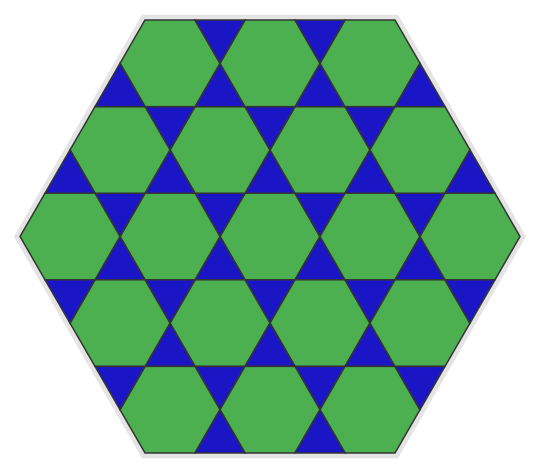
3.6.3.6 — the trihexagonal tiling. Two triangles and two hexagons meet at every vertex.Read the cycle in either direction; rotations and reflections of
the same string describe the same vertex. So 3.6.3.6, 6.3.6.3,
3.6.3.6 (reversed) are all the same configuration. The
canonical form is the lexicographically smallest rotation — which
is one of the things the ring-seq
library exists to compute.
When a tiling has more than one kind of vertex, the notation
lists each vertex configuration, separated by semicolons:
3.3.4.3.4 ; 3.3.4.12 describes a 2-uniform tiling with two
distinct vertex types.
The 11 Archimedean tilings
The Archimedean tilings are the eleven edge-to-edge tilings of the plane built from regular polygons in which every vertex configuration is the same (1-uniform). Three of them are the regular tilings — triangles only, squares only, hexagons only. The other eight mix two or three polygon types.
| Notation | Name | Thumbnail |
|---|---|---|
3.3.3.3.3.3 | Triangular | 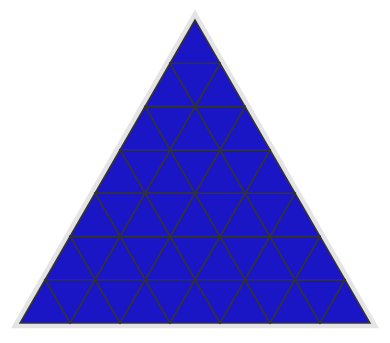 |
4.4.4.4 | Square | 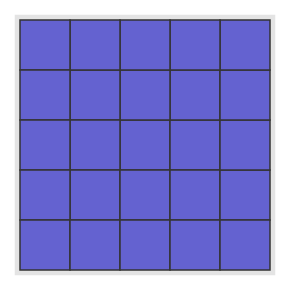 |
6.6.6 | Hexagonal | 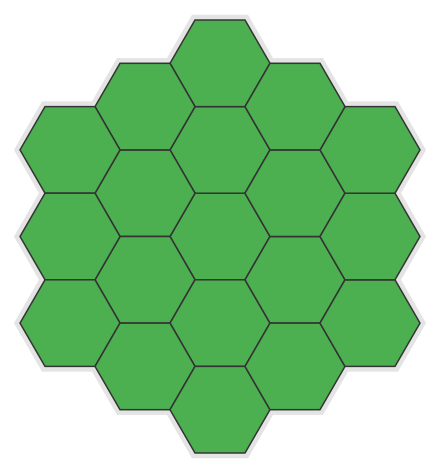 |
3.6.3.6 | Trihexagonal | |
3.4.6.4 | Rhombi-trihexagonal | 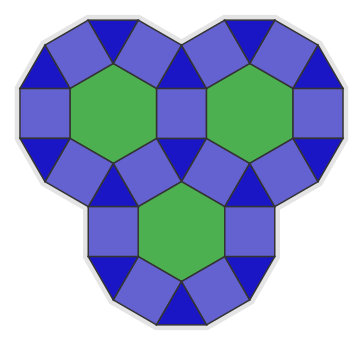 |
3.12.12 | Truncated hexagonal | 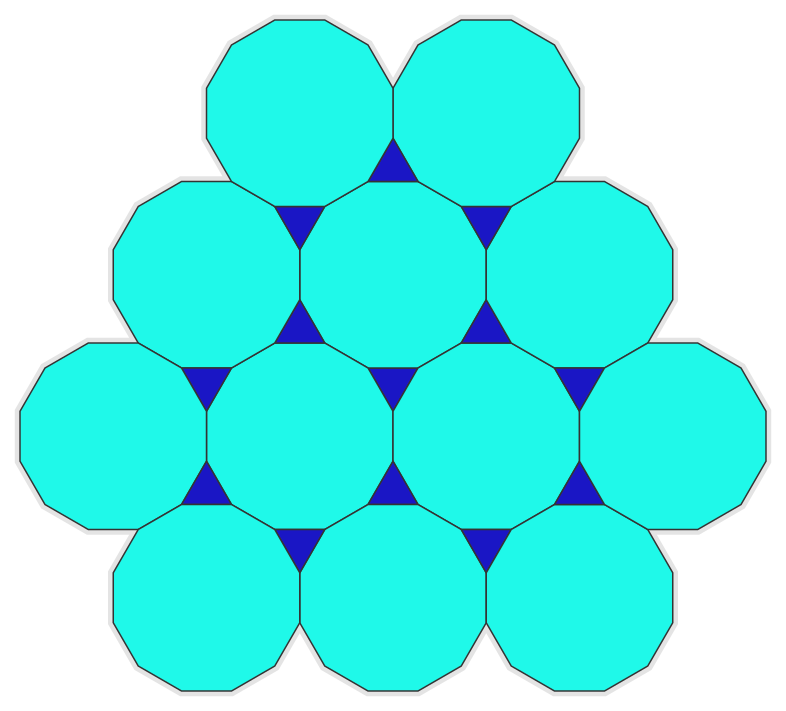 |
4.6.12 | Truncated trihexagonal | 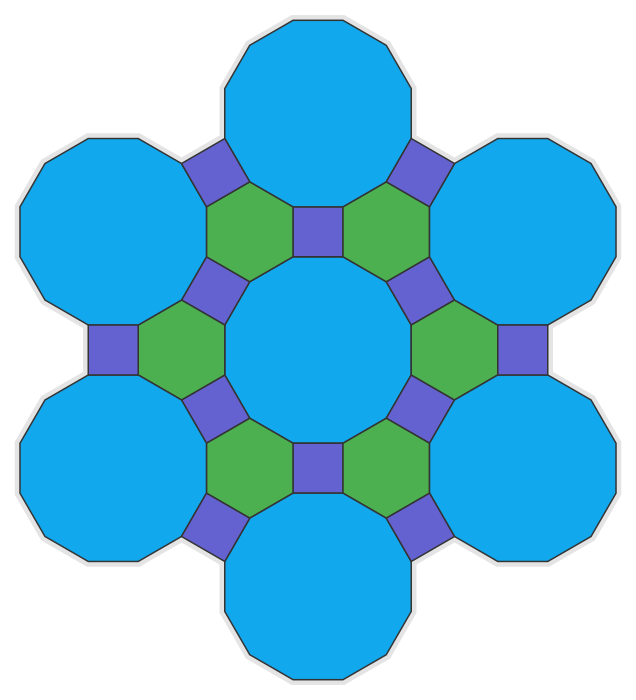 |
4.8.8 | Truncated square | 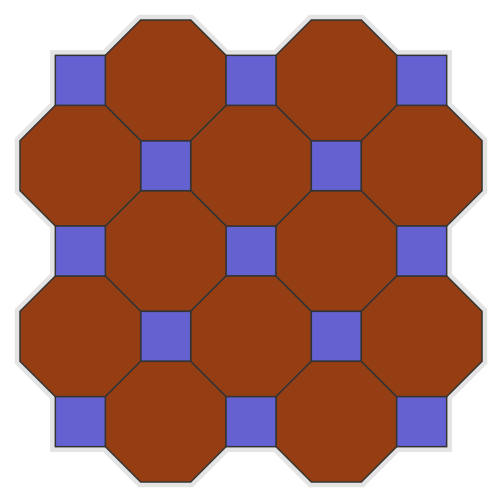 |
3.3.3.3.6 | Snub trihexagonal | 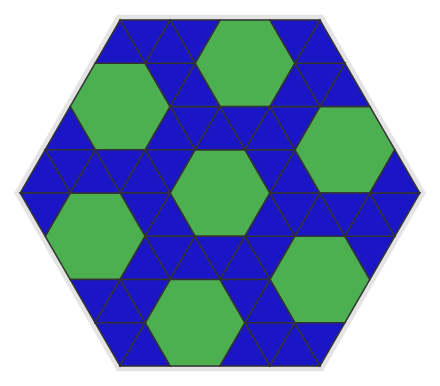 |
3.3.3.4.4 | Elongated triangular | 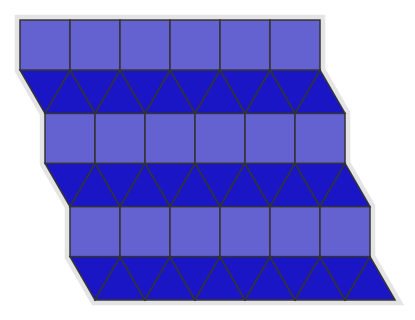 |
3.3.4.3.4 | Snub square | 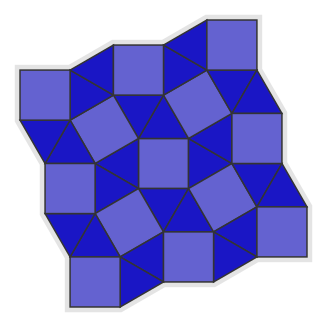 |
k-uniform tilings
A tiling is k-uniform if there are exactly k distinct vertex configurations under the tiling’s symmetry group. The Archimedean tilings are 1-uniform. There are 20 known 2-uniform tilings, and the count grows quickly with k.
Canonical sources for the full classification:
- B. Grünbaum and G. C. Shephard, Tilings and Patterns (1987).
- The Wikipedia page on Euclidean tilings by convex regular polygons is a serviceable secondary reference.
Glossary
- Edge-to-edge. A tiling is edge-to-edge when every shared border between two tiles is a complete edge of both — no T-junctions.
- Vertex configuration. The cyclic sequence of polygons around a vertex, written in vertex notation.
- Uniformity. The number of distinct vertex configurations under the tiling’s symmetry group. 1-uniform = Archimedean.
- Symmetry group. The group of rigid motions (translations, rotations, reflections, glide reflections) that map the tiling onto itself.
- Demiregular. A non-standard term sometimes used for 2- or 3-uniform tilings; ambiguous enough that we avoid it on this site.