How to read vertex notation
What 3.6.3.6 actually means, and why the same vertex has many equally valid spellings.
If you have spent any time around tilings you have probably seen
strings of digits separated by full stops — 3.6.3.6, 4.8.8,
3.3.3.3.6. They look like cryptic file extensions; they are in
fact one of the densest pieces of notation in mathematics.
Here is the rule. Stand at a vertex. Look at the polygons that meet there. Walk around the vertex, in either direction, and write down the number of sides of each polygon you pass.
That is it.
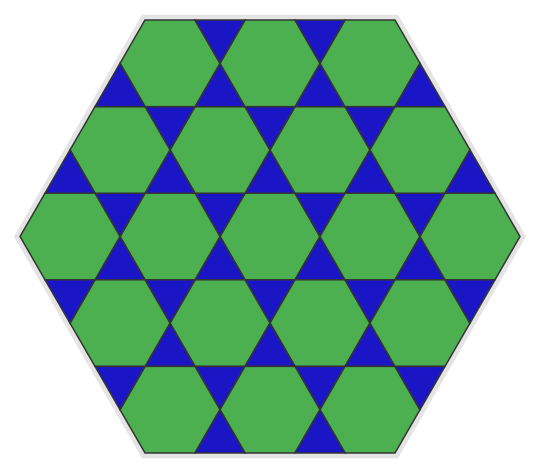
3.6.3.6: triangle, hexagon, triangle, hexagon. Four polygons, alternating.Same vertex, many spellings
3.6.3.6 and 6.3.6.3 describe the same vertex — you just started
walking from a different polygon. So do 3.6.3.6 reversed
(reading anticlockwise instead of clockwise) and any rotation of
those.
So a vertex configuration is really an equivalence class of strings: anything related to the others by rotation or reflection is the same vertex. We pick a canonical representative — usually the lexicographically smallest rotation — when we need a unique spelling for, say, comparing two tilings programmatically.
This is exactly what the ring-seq
library is for. Treat the string as a ring; the smallest rotation
is the canonical form.
More than one kind of vertex
Some tilings have more than one kind of vertex. The notation
extends naturally: list each vertex configuration, separated by
semicolons. 3.3.4.3.4 ; 3.3.4.12 is a 2-uniform tiling — two
distinct vertex types, each appearing repeatedly.
The number of distinct vertex types is the tiling’s uniformity. The 11 Archimedean tilings are 1-uniform; there are 20 known 2-uniform tilings; the count grows fast.
For a fuller treatment — k-uniform tilings, the 11 Archimedean tilings, and a short glossary — see the notation primer.